HS25: Stichus unbound: Manumission and freedmen in the Roman Empire
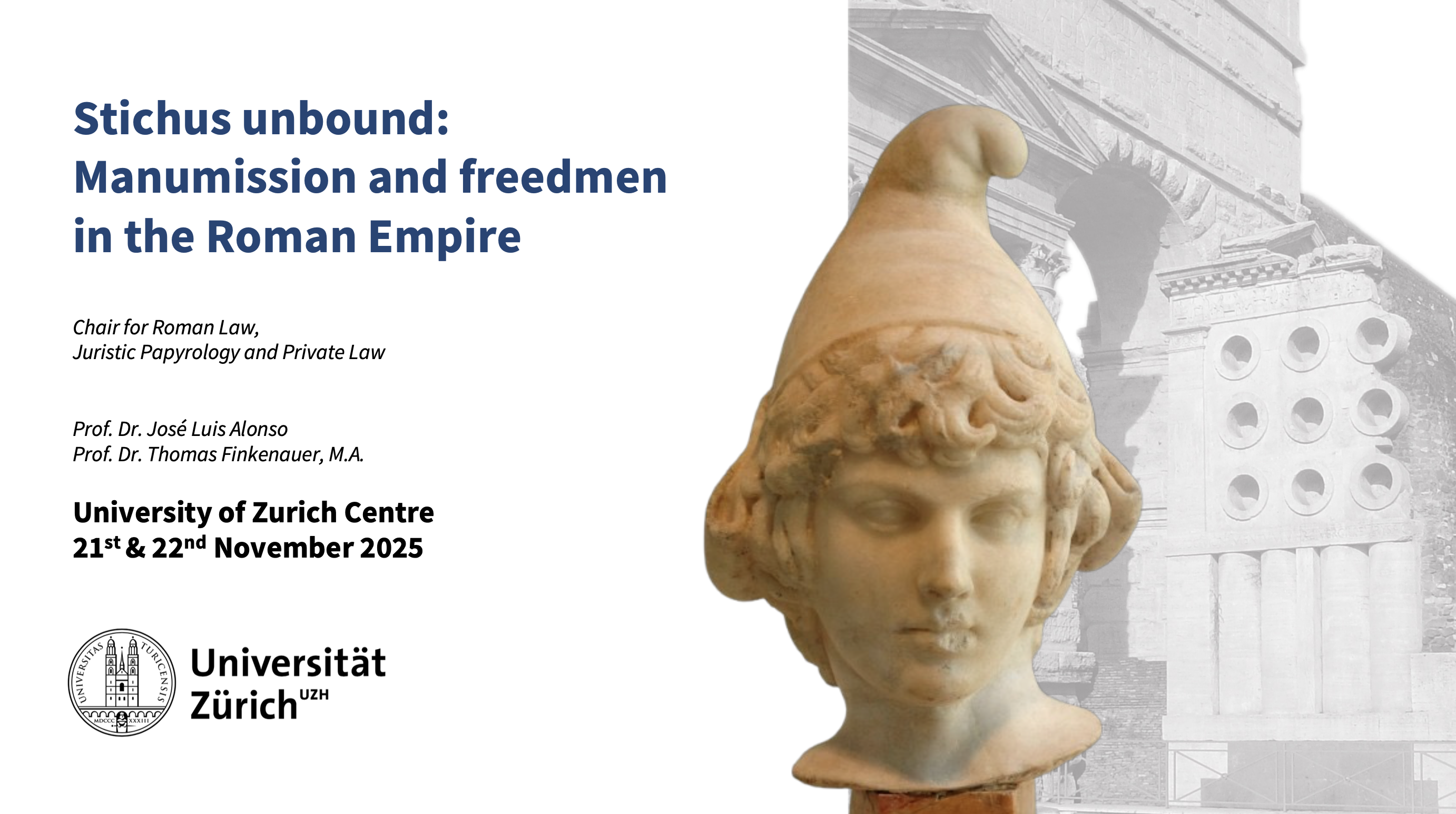
(V-Nr. 4143 4144)
| Description | The ancient societies were slave-owning societies. Economy and trade were unimaginable without slaves and freedmen. Slaves were – although recognised as persons under sacred and natural law – considered private law transactions as objects, which could be sold, pledged or made the subject of a usufruct. However, Roman slaves could also be endowed with a peculium by their masters, which allowed them to conduct business freely and, upon accumulating a certain wealth, often even to buy their freedom. The manumission of slaves played a major role in Roman legal life. Various forms were developed for this purpose. The regular form of manumission led not only to freedom but also to the acquisition of Roman citizenship. This was most likely the reason why Emperor Augustus passed legislation to limit the number of manumissions. Manumissions were carried out for various reasons: for self-aggrandizing, out of gratitude or as a reward, due to familial bonds with the slave, as recognition of good management of the slave’s peculium, etc. Indeed, as numerous inscriptions across provinces show, slaves had good chances of gaining their freedom over the course of their lives. For the Roman jurists, freedom was the highest personal legal status and generally in the Roman tradition the highest value both in private law and in politics. As early as the Twelve Tables, it had been recognised as a maxim that manumission, where possible, should be favoured by law and its interpreters (favor libertatis). Especially in the 2nd century CE, the decisions of the Roman jurists were shaped by favor libertatis and were likely influenced by the natural law thinking of the Greek Stoics.
List of topics: Topic 1: To Seem or To Be: The Roman Trial on Freedom Topic 2: Manumission with the Rod Topic 3: Social Engineering: Manumission Restrictions under Emperor Augustus Topic 4: In the Imperial Court of Marcus Aurelius: Testament, Treasury, and Freedom Topic 5: Interpretation of Wills and the Promotion of Freedom Topic 6: Manumission of Enslaved War Prisoners Topic 7: Manumitted but not Free: The Paradoxes of Conditional Manumission Topic 8: Freedom in Installments? Partial Manumission in Law and Practice Topic 9: Free but not Equal: The Paradoxical Existence of Those Informally Manumitted Topic 10: From Oppression to Responsibility: The Protection Dutys of the Manumitter Topic 11: Gratitude as a Duty: The Deference (obsequium) of the Freedmen Topic 12: Freedom Through Service: The Work of the Freedmen Topic 13: Manumission as an Investment: The Inheritance Claims of the Manumitter Topic 14: Imperial Freedmen as Court Officials Topic 15: Manumission Through Sale to a God in the Greek Tradition Topic 16: Non-Roman Forms of Manumission in Roman Egypt
Credits and records: The seminar is open to bachelor and master students. Bachelor’s theses are awarded 6 ECTS and must be approximately about 62,500 characters (ca. 25 pages). Master’s theses can only be written to the extent of 12 ECTS, which corresponds to a thesis of approximately 100,000 characters (ca. 40 pages). The stylesheet of the Chair Prof. Alonso sets out requirements that must be observed with regard to the bachelor's and master's theses. |
|---|---|
| Date and Place |
Preliminary Meeting: April 14th, 2025 at 12:15; via Zoom (link in the seminar guidelines)
Introductory Meeting: May 12th, 2025 at 12:15; via Zoom (link here (PDF, 62 KB))
Seminar: November 21st and 22nd 2025; Zurich
|
| Participation and further Information |
For the procedure and further information please consider the seminar guidelines (PDF, 1 MB)
The application for the seminar runs through the application tool of the faculty. If you have any questions regarding the content of our seminar don't hesitate to contact us: lst.alonso@ius.uzh.ch
|
Prof. Dr. Thomas Finkenauer, M.A.

Thomas Finkenauer is a legal scholar at the University of Tübingen, where he is full professor in Civil Law, Roman Law, and European Private Law since 2005. After studying law and history at the University of Trier, he passed the First and Second State Examinations and was awarded a doctorate in 1999 for his dissertation titled “Eigentum und Zeitablauf – das dominium sine re im Grundstücksrecht”. In 2005, he obtained the venia legendi for Civil Law, Roman Law, and the History of Modern Private Law with his habilitation thesis on “Vererblichkeit und Drittwirkungen der Stipulation im klassischen römischen Recht”.
Thomas Finkenauer counts among the most prominent Romanists of our time. His research focuses on private law, within which he has addressed a wide range of topics, his work on property, stipulation and slavery law being particularly noteworthy. As a law historian, his research has primarily dealt with the formation of the German Civil Code (BGB). His œuvre also extends to contemporary law, particularly in the fields of contract and inheritance law.
You can find more about the person here